Can Plasma Be Alive? The Strange Case of Self-Organizing Space Dust
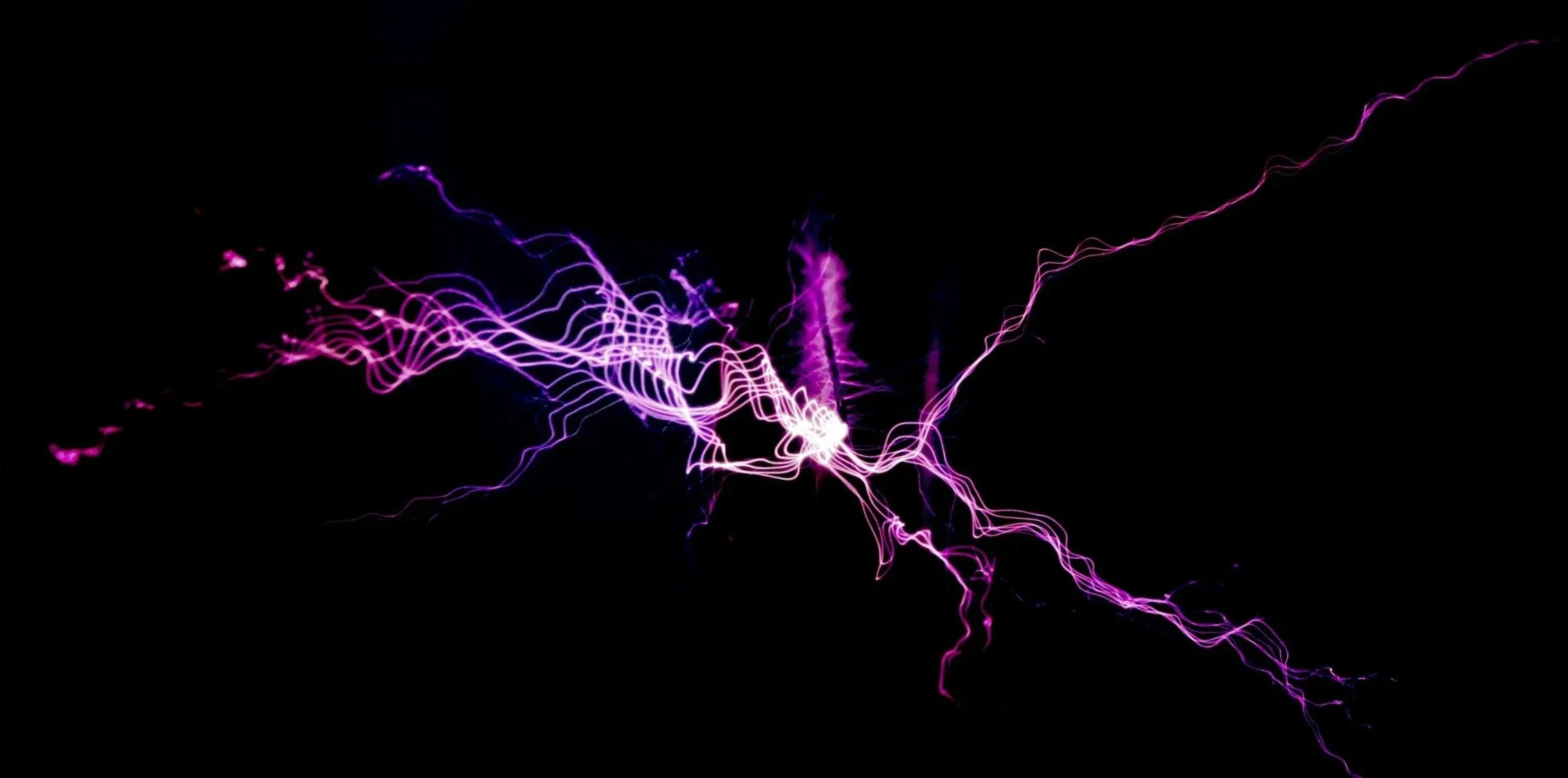
Life, as we've always defined it, is built from carbon, water, and organic chemistry. But a 2007 study out of the Russian Academy of Sciences put forward a genuinely strange challenge to that assumption: under the right conditions, plasma — the ionized, electrically charged "fourth state of matter" found in stars, lightning, and interstellar dust clouds — can organize itself into structures that check nearly every box biologists use to define life. Not organic life. Something else entirely.
What the researchers found
Plasma is usually thought of as chaotic — a soup of free electrons and charged particles with little inherent order. Using computer simulations of molecular dynamics, physicist V.N. Tsytovich and colleagues showed that under specific conditions, microparticles suspended in a plasma can separate into charged regions and spontaneously twist into stable, helical, corkscrew-shaped structures — visually reminiscent of DNA (Tsytovich et al., 2007).
That alone would be a curiosity. What made it more than that was what the structures did next. According to the study, these helical plasma configurations exhibited:
Self-duplication — replicating their structure under the right plasma flux conditions
"Memory marks" — stable bifurcation points that preserved information about the structure's history
Metabolic-like activity — energy exchange within a thermodynamically open system
Non-Hamiltonian dynamics — behavior patterns typically associated with living, energy-consuming systems rather than simple physical equilibrium
The researchers concluded that these self-organized plasma structures met the standard scientific criteria used to define life — autonomy, evolution, progeny, and autopoiesis (self-maintenance) — and proposed they could qualify as a form of inorganic living matter (Tsytovich et al., 2007).
Why this matters beyond a lab curiosity
The conditions needed to generate these helical structures aren't exotic. They occur naturally in interstellar dust clouds, and can also form under far more mundane circumstances — including near a lightning strike. That's led some researchers to speculate that an early, inorganic form of self-organizing matter might have existed on the primordial Earth before organic chemistry ever got started, or that plasma-based "life" could be common elsewhere in the universe under conditions where carbon-based biology could never take hold (ScienceDaily, 2007).
The implications, if taken seriously, are significant for astrobiology: the search for life elsewhere in the universe has historically been built almost entirely around looking for the chemical signatures of carbon-based, water-dependent biology. If self-organizing plasma structures genuinely meet the definition of life, that search may be looking in the wrong places entirely.
A necessary dose of caution
This remains a niche and debated area of physics, not an accepted addition to biology. The original findings come from a single 2007 paper and its authors' own follow-up work; they have not been independently replicated in physical experiments at the scale the theory implies, and the "living" plasma described exists only under specific laboratory or simulated conditions, not as anything resembling a self-sustaining organism in the wild. Whether meeting a checklist of criteria — autonomy, replication, memory — is the same as being alive is itself a long-standing and unresolved question in the philosophy of biology, independent of plasma physics entirely. Some later citations of this work have also drifted into far more speculative territory (interstellar objects, UAP theories) that go well beyond what the original research actually claims.
Still, the core finding is a real and interesting one: matter doesn't need carbon chemistry to spontaneously organize itself into complex, self-replicating, information-preserving structures. Whether that qualifies as "life" is a definitional argument as much as a scientific one — but it's a genuinely open question, not a settled no.
References
Tsytovich, V.N., Morfill, G.E., Fortov, V.E., Gusein-Zade, N.G., Klumov, B.A., & Vladimirov, S.V. (2007). From plasma crystals and helical structures towards inorganic living matter. New Journal of Physics, 9, 263. https://doi.org/10.1088/1367-2630/9/8/263
Institute of Physics. (2007, August 14). Physicists Discover Inorganic Dust With Lifelike Qualities. ScienceDaily. https://www.sciencedaily.com/releases/2007/08/070814150630.htm
