Why Scientists Keep Putting Cats in Their Thought Experiments
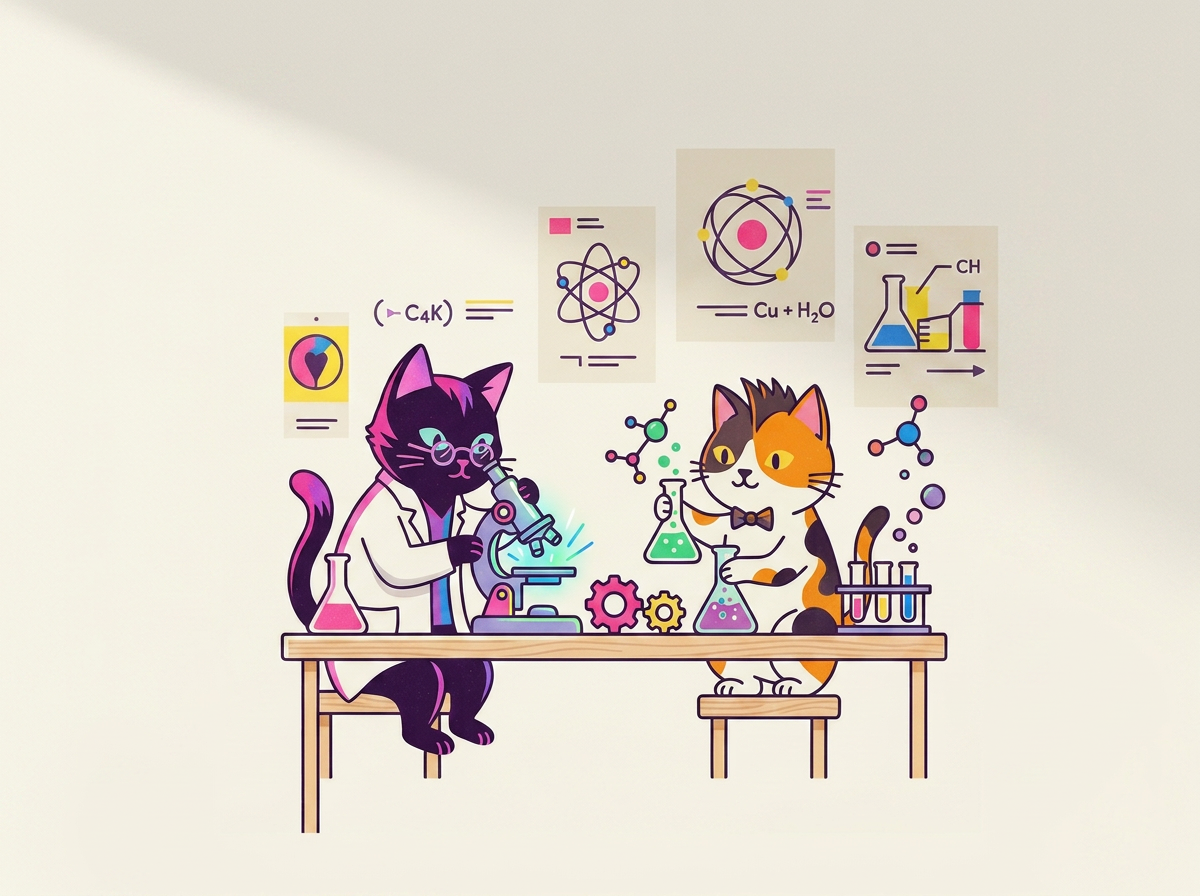
Scientists have an odd habit: when an abstract concept becomes difficult to explain, a cat appears.
The most famous example is Schrödinger's cat. In 1935, physicist Erwin Schrödinger imagined a cat inside a sealed box, connected to a quantum event that had a 50 percent probability of occurring. If the event occurred, the cat would die; if it did not, the cat would live. Schrödinger was not proposing that a real cat could literally be both alive and dead. He was using the cat to demonstrate how strange quantum mechanics becomes when its mathematical description of tiny particles is extended to the familiar world around us.
The choice of a cat was almost perfect. A particle in a quantum state is difficult to imagine. A cat is not. We know what it means for a cat to be alive. We know what it means for one to be sitting inside a box, waiting for us to open it. The thought experiment turns an abstract problem into something emotionally and intuitively understandable.
And scientists have continued to return to cats.
There is the Cheshire Cat, borrowed from Alice's Adventures in Wonderland. In quantum physics, "quantum Cheshire Cat" describes experiments in which a particle and one of its properties can behave as though they have become separated. The metaphor is whimsical, but it is also strangely appropriate: the cat disappears while its grin remains behind.
Then there is the famous "buttered cat" paradox, which combines two observations that are difficult to resist: cats tend to land on their feet, while buttered toast tends to land butter-side down. The resulting thought experiment is mostly a joke, but the behavior of falling cats is a genuine subject of physics. Cats have an extraordinary ability to rotate their bodies during a fall and orient themselves toward the ground, and researchers have studied the mechanics that allow them to do it.
There is also a cat who became, technically, a scientific author.
In 1975, physicist Jack Hetherington wanted to publish a paper using the word "we," but the journal required a single author. Rather than rewrite the paper, he listed his cat, Chester, as a co-author under the name F. D. C. Willard. Willard subsequently appeared on additional papers and even accumulated scientific citations.
It is difficult not to find something endearing about this. Scientists spend their lives trying to describe the world precisely, and yet one of them apparently decided that the most efficient solution to a publication problem was to give his cat a scientific identity.
Cats have also found their way into artificial intelligence.
In 2012, researchers at Google's X laboratory trained a large neural network on millions of unlabeled images from YouTube videos. They did not tell the system what a cat was or provide it with labeled examples. After examining an enormous number of images, the network developed a feature that responded strongly to pictures of cats. The experiment became famous as the "Google cat."
The result was funny because it involved a cat, but the scientific question was serious. How does a machine learn to recognize something when nobody explicitly tells it what that thing is?
A cat is actually a remarkably good test of this question.
Humans recognize cats almost effortlessly. We can recognize a tiny kitten, a large cat, a long-haired cat, a black cat sitting in the shadows, or a cat photographed from an unusual angle. We do not consciously calculate the shape of its ears, the ratio of its eyes to its face, the texture of its fur and the arrangement of its limbs. Somehow, all of those features become a coherent perception: cat.
Yet the concept is more complicated than it initially appears.
What exactly makes a cat a cat? Is it its anatomy? Its behavior? Its appearance? Its genetic lineage? The way it interacts with its environment? And when an artificial neural network learns to recognize cats, has it learned something about the concept itself, or has it simply found a very complicated statistical pattern?
This is where the history of cats in science becomes more interesting than it first appears.
Schrödinger's cat helped physicists think about the relationship between mathematical descriptions and physical reality. Falling cats have helped physicists understand motion and orientation. The Google cat became an example of machine learning discovering meaningful patterns without explicit instruction.
The same animal keeps appearing because cats are unusually rich objects of observation. They are familiar, but not simple. They are highly responsive to their environment, capable of learning, remarkably coordinated physically, and often difficult for us to predict. They have recognizable individual personalities while still sharing the characteristics that make them unmistakably cats.
And perhaps there is another reason scientists keep choosing them.
Cats are creatures we have lived alongside for thousands of years, but they have never become completely transparent to us. We can study their brains, their genetics, their movements and their behavior, yet a cat still retains a little independence from our explanations. It has its own way of moving through the world.
That makes the cat a particularly appealing companion for scientific thought.
We put a cat in a box to think about quantum reality. We study a falling cat to understand physics. We teach machines to recognize cats in order to understand artificial perception.
The cat, meanwhile, remains largely concerned with being a cat.
Perhaps that is part of what makes the examples so memorable. We keep using cats to help us understand some of the deepest questions in science, while the animals themselves continue to be wonderfully, stubbornly mysterious.
Scientists are not alone in finding something special in cats. Across Buddhist traditions and other contemplative traditions, cats have also had a long and sometimes intimate place in spiritual life, valued for their quiet presence, independence, attentiveness, and ability to simply inhabit the present moment. Perhaps it is not so surprising that an animal so naturally curious to scientists has also been a companion to people contemplating the nature of consciousness itself.
It seems like a pretty good arrangement for everyone.
