The Barabar Caves: India's Oldest Mystery, Carved in Stone
In the granite hills of Bihar, about 24 kilometers north of Gaya, sits a set of caves that shouldn't be possible — not for their age, and not for what's actually inside them. The Barabar Caves are the oldest surviving rock-cut caves in India, carved during the Mauryan Empire more than 2,300 years ago. And more than two millennia later, archaeologists still can't fully explain how they were made, or why.
A mirror carved into solid rock
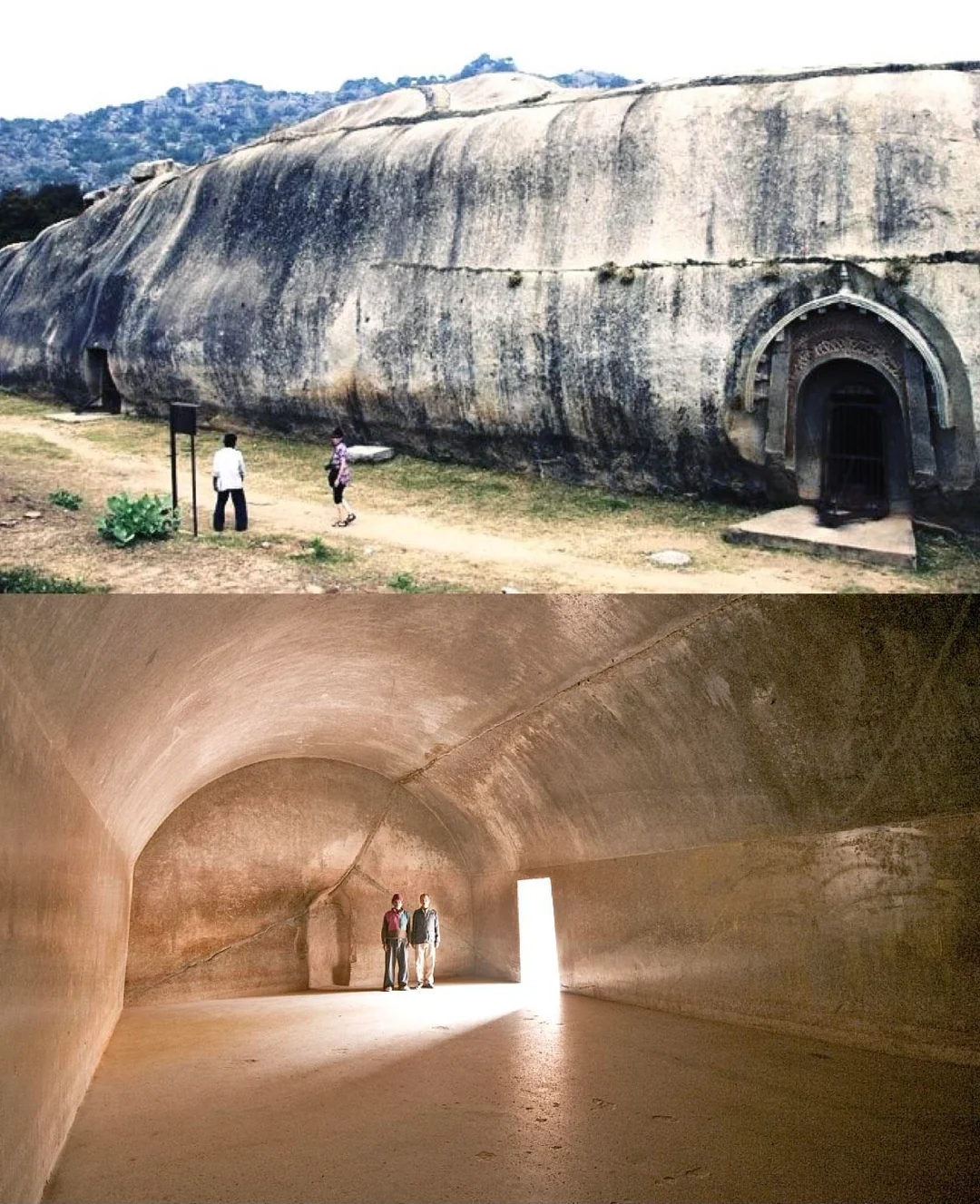
The single strangest thing about the Barabar Caves is their interior finish. Using nothing but hand tools, Mauryan-era craftsmen polished the granite walls to a glass-like, mirror-bright sheen — smooth and reflective enough to catch and bounce light like a black mirror. This is granite, one of the hardest, most stubborn stones to shape. Achieving that kind of finish with modern machinery is a serious undertaking. Doing it by hand, over 2,000 years ago, is something no one has fully reverse-engineered.
Even stranger: the technique appears to have simply vanished. No later Indian rock-cut sites — not even the far more famous Ajanta and Ellora Caves — ever matched this level of polish again. Whatever knowledge produced it seems to have died with the people who had it.
Built for silence, but designed for sound
Step into one of the caves and speak, and something unexpected happens: the sound doesn't just echo, it wraps around you. The domed, semi-hemispherical inner chambers act almost like natural amplifiers, holding a ringing resonance that can last several seconds after a single word or note. Many archaeologists believe this wasn't an accident. The caves were built as retreats for the Ajivikas, an austere ascetic sect whose practices likely involved chanting and ritual recitation — and an acoustic effect this precise, in a chamber this deliberately shaped, is hard to write off as coincidence.
A sect that vanished from history
The caves weren't built for Buddhist monks, despite their strong Ashokan connection. They were dedicated to the Ajivikas — a philosophical movement that rivaled Buddhism and Jainism in its own time, founded by a contemporary of the Buddha named Makkhali Gosala. The Ajivikas believed human fate was entirely predetermined, with no room for free will to alter it — a worldview that put them at odds with both Buddhist and Jain teachings.
They thrived for a while under Mauryan patronage. Then they simply disappeared. None of their own texts survived. Nearly everything we know about the Ajivikas today comes secondhand, filtered through the writings of their philosophical rivals — which is a little like trying to understand a religion using only the pamphlets of the people who opposed it. An entire belief system, prominent enough to receive royal-commissioned caves, was essentially erased from its own record.
An emperor's signature, hidden in stone
Several of the caves carry inscriptions in Brahmi script confirming they were personally dedicated by Emperor Ashoka — one of the most consequential rulers in Indian history — with additional caves added later by his grandson, Dasharatha. It's a rare case of being able to place a specific, named ruler at a specific, dateable ancient site, which makes the caves as valuable to historians as they are eerie to visit. One inscription even uses the title "Priyadarsin" — "he who brings joy" — a name Ashoka used for himself after his well-documented turn toward Buddhist nonviolence.
The unfinished cave
Not every cave was completed. The Lomas Rishi Cave — the most photographed of the group, with its distinctive arched, ogee-shaped entrance imitating a thatched wooden hut — has no interior polish and no Ashokan inscription at all. Some researchers think the vaulting posed structural problems the builders never solved; others suspect work simply stopped, for reasons lost to time. Either way, it's a rare, frozen glimpse of a 2,300-year-old construction project abandoned mid-task.
This missing inscription has also fueled a genuine scholarly disagreement. The standard explanation is that Lomas Rishi was simply left unfinished by Ashoka's workers. But some researchers have pushed back on that, pointing out that a neighboring cave, Visvakarma, was also incomplete yet still received an Ashokan dedication — which undercuts the idea that incompleteness alone would have kept Lomas Rishi from being inscribed. That's led to an alternate theory: Lomas Rishi may not have been carved under Ashoka at all, but sometime after his reign, by later hands entirely. It's a narrow, cave-specific debate rather than a challenge to Ashoka's role at Barabar overall — but it's a reminder that even the site's best-documented history has real gaps once you look closely.
Worth acknowledging: dating a rock-cut chamber almost entirely from a handful of inscriptions is inherently uncertain work. There's no independent method here to confirm a cave and its dedicatory text were carved in the same year rather than the text being added to an already-standing space — the field's conclusions rest heavily on stylistic judgment and a small set of comparative examples like Visvakarma.
A broader note: some readers will look at debates like this and see a familiar pattern — in many scientific fields, entrenched consensus can be slow to update, in part because of the funding and career incentives that reward sticking with the accepted view. Whether or not that dynamic is at play here specifically, the Lomas Rishi debate is a good reminder that "settled" archaeological history is often more contested than a museum placard suggests.
An unexpected literary afterlife
The caves' strangeness didn't stay buried in Bihar. E.M. Forster visited them, and they became the inspiration for the mysterious Marabar Caves in his 1924 novel A Passage to India — the setting for the book's central, unexplained incident, and a scene featured prominently in the Academy Award–winning film adaptation. It's a fitting second life for a place already defined by an event nobody can fully account for: an ancient site so opaque that even a novelist reached for it as the perfect symbol of the unknowable.