The Code Book: The Science of Secrecy from Ancient Egypt to Quantum Cryptography
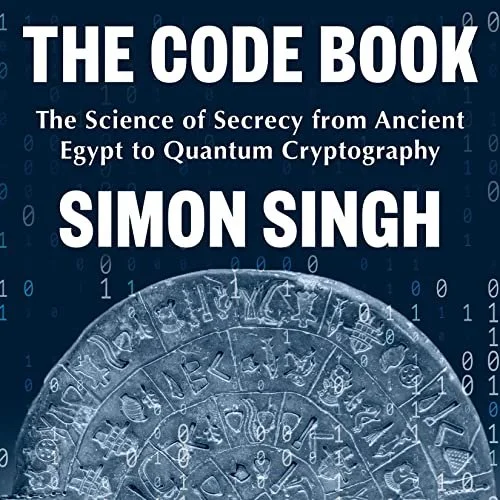
by Simon Singh
Simon Singh trained as a particle physicist at Imperial College London and Cambridge before moving into science journalism at the BBC, where his 1996 documentary on Fermat's Last Theorem won a BAFTA. That combination — real technical grounding paired with a talent for narrative explanation — carries through The Code Book, published in 1999, his second book after the bestselling Fermat's Enigma.
The book traces the history of cryptography as a series of escalating duels between code-makers and code-breakers, moving from the Man in the Iron Mask and ancient scripts like Linear B, through Arabic cryptanalysis and Charles Babbage, to the Enigma machine's role in World War II, and finally into modern public-key cryptography, PGP, and the emerging territory of quantum cryptography. Rather than presenting these as disconnected trivia, Singh frames the whole book around a single throughline: every new code eventually gets broken, which forces the next code to be smarter, in a cycle that runs from antiquity straight through to how your data is encrypted today.
A fun, concrete detail: the original edition included a cipher challenge with a £10,000 prize attached, which was eventually solved — a good indicator of how seriously the book treats the actual mechanics of code-breaking rather than just the history around it.
I'd recommend it to readers who enjoy popular science and history told through a single technical thread, especially anyone curious about how cryptography actually works rather than just why it matters. It's written for a general audience — no background in math or computer science required — and it's a good entry point if you want the historical throughline before moving into denser, more technical treatments of modern cryptography.
View & Purchase on Amazon
