Creating Capabilities: The Human Development Approach
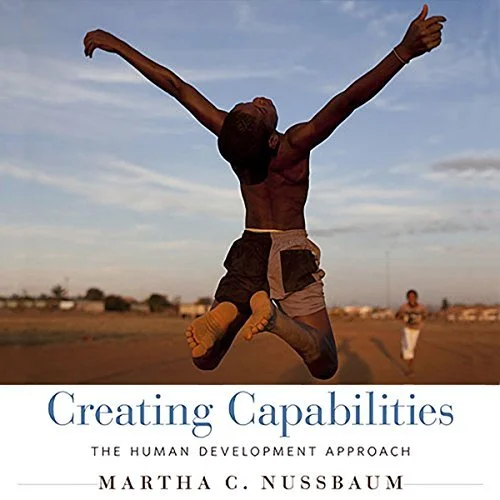
by Martha Nussbaum
Martha Nussbaum built her career arguing that how we measure a good life matters as much as what we do about it, and Creating Capabilities is her most compact statement of that argument. Published by Harvard University Press in 2011, the book makes the case against judging a country's progress mainly by GDP or income growth, and argues instead for asking a more direct question: what is each person actually able to do and be?
That question is the foundation of the "capabilities approach," a framework Nussbaum developed alongside economist Amartya Sen. Rather than measuring wellbeing by resources or wealth alone, it asks whether people have the real, substantive freedom to live the kind of life they have reason to value. Nussbaum lays out ten "central capabilities" she argues any decent society should secure for its people: life; bodily health; bodily integrity; senses, imagination, and thought; emotions; practical reason; affiliation; relationships with other species; play; and control over one's environment (political and material). Much of the book is spent defending why this list, and why capabilities rather than income, should be the basis for social policy and international development work.
A few things worth knowing before picking it up: this is a work of political philosophy, not a narrative or popular-science book. It's compact — around 240 pages — but dense and argument-driven, written for readers willing to sit with formal philosophical reasoning. It's a strong fit if you're interested in social justice, international development, disability studies, or public policy and want the primary-source version of an idea that has shaped how organizations like the UN think about measuring human progress. It's a harder recommend if you're looking for something conversational or example-driven — this is Nussbaum making a sustained philosophical argument, not telling stories.
View & Purchase on Amazon
🎧 Audiobook
📖 Paperback Edition
📱 Kindle Edition
