Why Healing Isn't Just in Your Mind
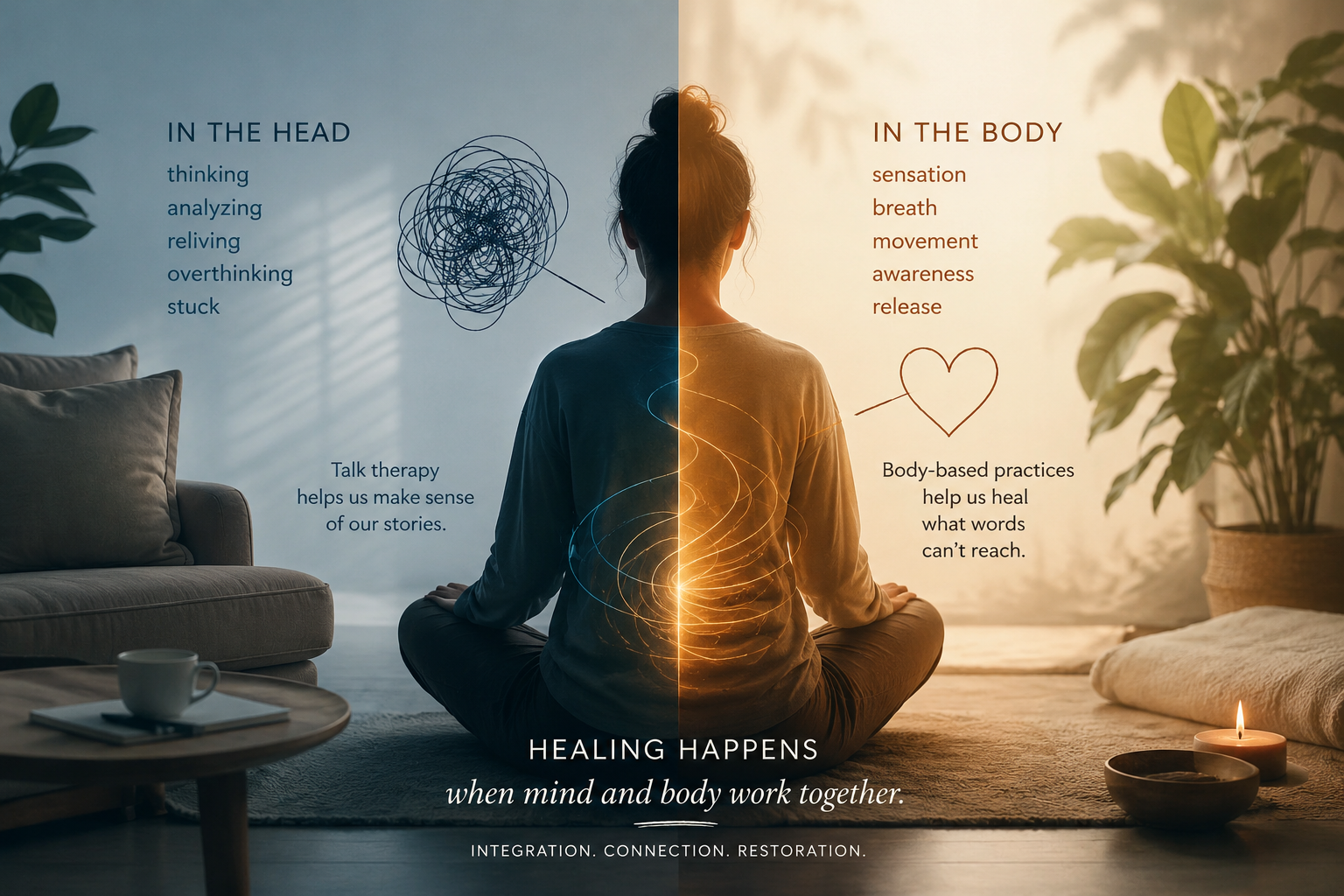
When people think about therapy, they often imagine sitting in a chair and talking through difficult experiences. For many concerns, this can be profoundly helpful. Putting experiences into words, gaining insight, and making sense of our emotions are important parts of healing.
But for many people—particularly those living with chronic stress, anxiety, trauma, or burnout—healing involves more than changing thoughts alone.
Our nervous system responds to life's experiences long before we consciously analyze them. Stress can show up as muscle tension, shallow breathing, digestive discomfort, chronic fatigue, difficulty relaxing, or a persistent sense that something isn't quite right. Even when we intellectually understand what happened to us, our bodies may continue responding as though the danger is still present.
This is one reason body-based approaches have become an increasingly important part of modern psychological care. Practices such as mindful movement, breathwork, somatic awareness, progressive relaxation, and other nervous system regulation techniques help us notice and work with the body's responses rather than relying on insight alone.
This doesn't mean that traditional talk therapy is ineffective. In fact, for many people it is an essential part of recovery. Rather, insight and conversation are often most effective when combined with approaches that also help regulate the nervous system and restore a sense of safety in the body.
Healing is rarely just about understanding our experiences intellectually. It is also about learning to feel grounded, present, and safe again.
For anyone interested in understanding this mind-body connection more deeply, I highly recommend The Body Keeps the Score by Bessel van der Kolk. It remains one of the most influential books on trauma, nervous system regulation, and the science of healing, and explains why recovery often involves both psychological insight and embodied experience.
