Stress vs. Nervous System Dysregulation: What's the Difference?
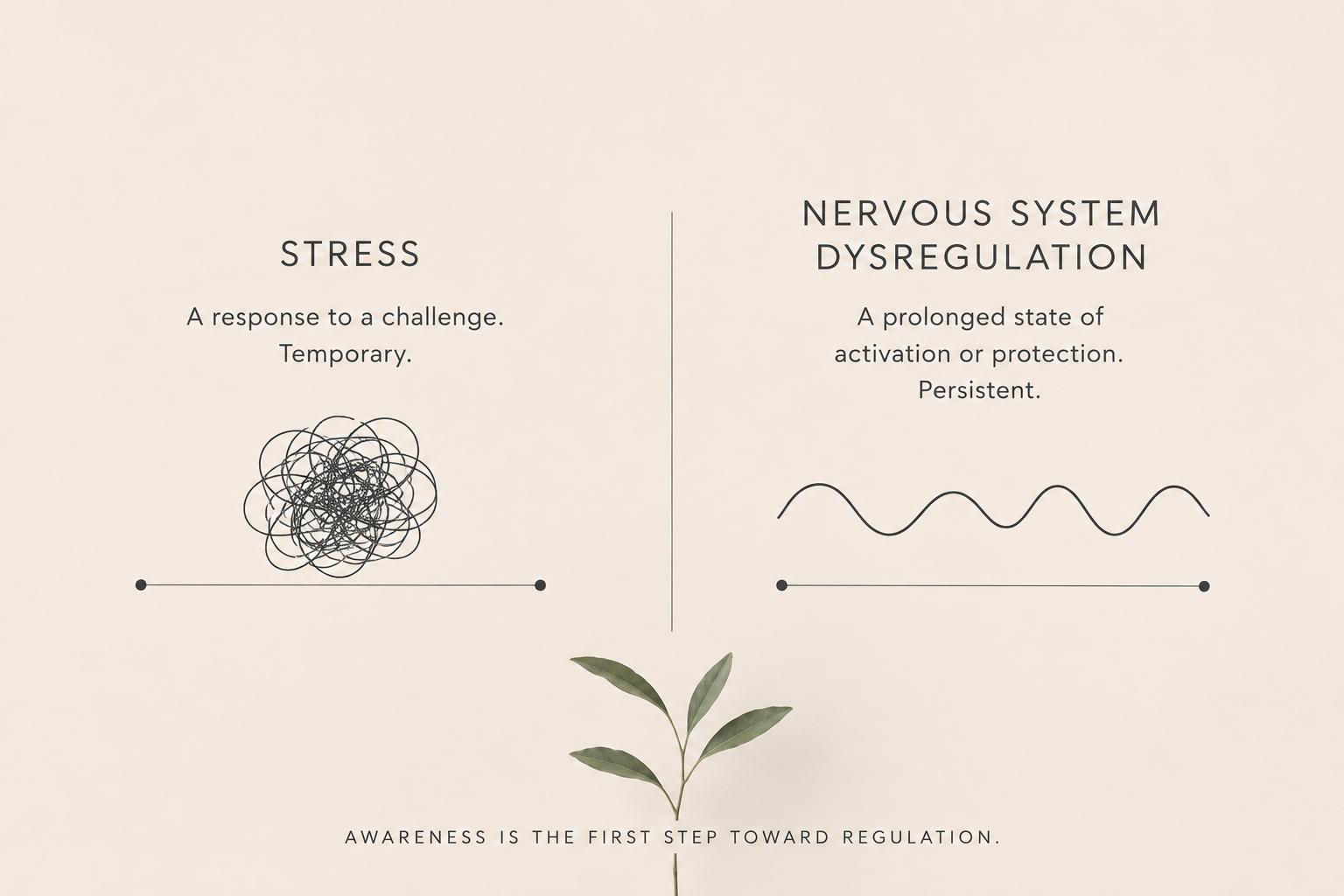
Most of us know what it feels like to be stressed. A deadline is approaching, work becomes overwhelming, or life presents one challenge after another. We feel tense, distracted, or emotionally drained. Once the stressor passes, however, our minds and bodies are often able to return to a sense of balance.
Nervous system dysregulation is different.
Rather than being a temporary response to life's demands, nervous system dysregulation occurs when the body remains in a prolonged state of activation or protection. Even when there is no immediate danger, the nervous system may continue behaving as though there is. This can make it difficult to fully relax, sleep deeply, concentrate, or experience a lasting sense of calm.
Some common signs of nervous system dysregulation include:
Feeling constantly "on edge" or unable to relax.
Difficulty sleeping or waking feeling exhausted.
Chronic muscle tension or shallow breathing.
Becoming easily overwhelmed by everyday situations.
Feeling emotionally numb or disconnected.
Difficulty concentrating or frequent racing thoughts.
A persistent sense that something is wrong, even when life appears to be going well.
These experiences are not signs of weakness or failure. They are often the result of a nervous system that has adapted to prolonged stress, uncertainty, or overwhelming experiences. While these adaptations may once have been protective, they can continue long after the original circumstances have changed.
Fortunately, the nervous system is capable of change throughout life.
Practices such as mindful breathing, gentle movement, yoga, somatic awareness, spending time in nature, restorative sleep, supportive relationships, and other evidence-informed approaches can help the nervous system gradually learn that it is safe to move out of survival mode. These practices are not about forcing relaxation, but about creating the conditions in which the body can begin to regulate itself again.
For many people, these approaches are most effective when combined with psychotherapy, allowing both the mind and body to participate in the healing process.
Understanding the difference between temporary stress and nervous system dysregulation can be an important first step toward healing. Rather than asking, "What's wrong with me?" it can be more helpful to ask, "What might my nervous system be trying to protect me from?"
Healing often begins not by fighting the body, but by learning to understand and work with it.
