When the Mind-Reading Breaks Down: Theory of Mind and Autism in Romantic Relationships
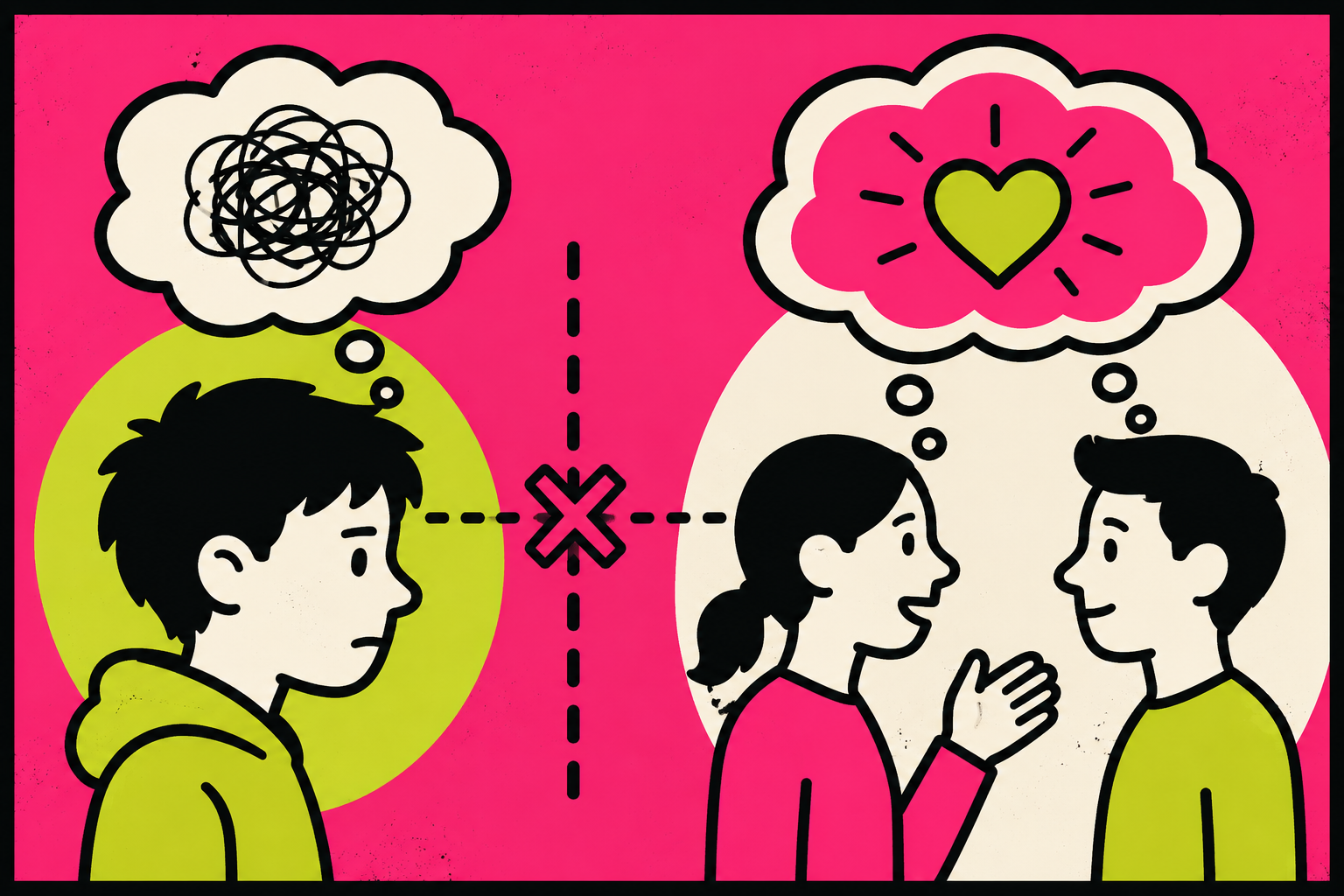
Theory of mind is the ability to infer what someone else is thinking or feeling — their beliefs, intentions, and emotional state — based on things like tone of voice, facial expression, body language, and context. It's not the same as caring about another person; it's the mechanism by which that care gets translated into an accurate read of what's actually going on with them. Difficulty with theory of mind is one of the more consistently described features of autism, though it's worth saying upfront that current research has moved away from treating it as a simple, fixed deficit — a widely cited 2025 critical evaluation of the theory of mind hypothesis found that none of the existing explanations fully account for how it actually shows up, and that it looks more variable and context-dependent than the earlier, simpler version of the theory suggested.
That variability matters most in exactly the setting where the stakes are highest: a romantic relationship. Most social contexts run on relatively low emotional stakes and fairly explicit signals. Romantic relationships run on the opposite — high emotional stakes (attachment, fear of loss, fear of disappointing someone you love) paired with a heavy reliance on subtle, unspoken cues: a shorter-than-usual reply, a change in tone, a sigh, a look. Neurotypical partners often expect these cues to be read correctly without being stated outright, and that's precisely the terrain where theory of mind differences are hardest to compensate for.
It helps to break the process into three separate steps: noticing a cue, inferring what it means, and reacting to that meaning. The first step — noticing that a tone shifted, or a reply came back shorter than usual — usually isn't where things go wrong. The third step, the emotional reaction, is just downstream of whatever conclusion got reached before it. The vulnerable step is the one in the middle: turning "this cue happened" into "this is what it means about how my partner feels toward me." That inference normally leans on a lot of small corrective information running in parallel — micro-expressions, subtle shifts in tone, context built up from this specific person over time — and those are exactly the signals that are harder to read in autism. Which means the same signals that would normally let someone catch and revise a wrong first guess before acting on it are also less available, so a shaky initial read has fewer chances to get corrected before it turns into a reaction.
Under emotional load, this gets compounded further: high arousal generally biases people, autistic or not, toward interpreting ambiguity as threatening rather than neutral. So a less reliable initial read starts out tilted toward the worse-case interpretation, with weaker odds of self-correcting before it becomes a full reaction. The result can look, from the outside, like jumping to a conclusion or overreacting to something small. From the inside, it's an attempt to resolve real uncertainty using the same tools everyone uses — tools that are simply less reliable here for this kind of fine-grained emotional reading, and that have less of a built-in check to catch it when they're wrong.
This is frequently compounded by alexithymia — difficulty identifying and naming one's own emotional state, which co-occurs with autism at a notably higher rate than in the general population. Someone who can't easily label "I'm feeling anxious" or "that hurt me" in the moment may still feel the physiological intensity of that emotion without the verbal handle to explain it — which can make a reaction seem sudden or disproportionate to an outside observer, when in fact the feeling had been building without being consciously named.
None of this means the resulting conclusion is accurate, or that it doesn't cause real friction — it does, and it's one of the more commonly cited sources of conflict in relationships involving an autistic partner. But the mechanism behind it is a difference in how ambiguous information gets processed under emotional pressure, not a lack of care or a tendency toward irrational thinking. Naming assumptions out loud and checking them directly, rather than acting on an inferred conclusion, is the most consistently cited way couples navigate this — not because the autistic partner is "wrong" for inferring, but because inference is exactly the step that becomes unreliable when the stakes and ambiguity are both high at once.
