Other Minds: The Octopus, the Sea, and the Deep Origins of Consciousness
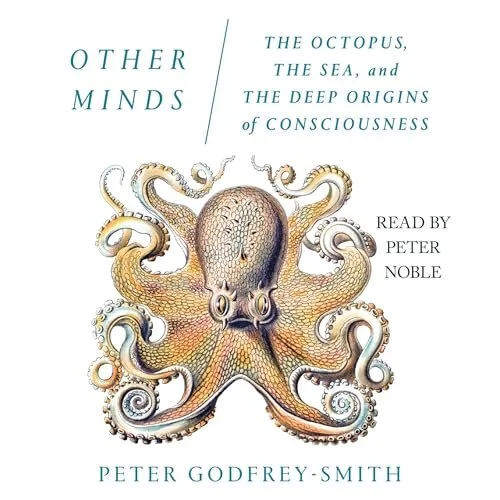
by Peter Godfrey-Smith
This is one of my favorite books of all time. I read it around the same time as The Mountain in the Sea, Ray Nayler's science fiction novel that's also built around octopus cognition, and the pairing made both books better — one grounded the other in real science, and the other let the ideas play out as fiction.
Other Minds was published in 2016 (Farrar, Straus and Giroux in the US; William Collins in the UK) and was shortlisted for the Royal Society Science Book Prize in 2017. Godfrey-Smith is an Australian philosopher of science specializing in philosophy of mind, and — notably for this book — an experienced diver who did his own underwater photography for it near Sydney.
The book's central argument is that intelligence evolved independently in cephalopods and in vertebrates like us, which makes octopus cognition, in Godfrey-Smith's words, probably the closest thing we'll get to meeting an intelligent alien. He builds a case that consciousness likely emerges gradually through a creature's active relationship with its environment rather than switching on all at once, and uses the octopus's strange, distributed nervous system — their arms alone contain nearly twice as many neurons as their brain — to ask what a genuinely different kind of mind might be like from the inside.
I'd recommend this to anyone interested in animal cognition, consciousness, philosophy of mind, or marine biology. It's written for a general audience and reads more like a curious, first-person investigation than a textbook — reviewers have called it delightfully written, and that's accurate. If you also enjoy science fiction, reading it alongside The Mountain in the Sea is genuinely worth doing; they talk to each other in a way that made me appreciate both more.
View & Purchase on Amazon
