Why Schrödinger’s Cat Doesn’t Stay in Superposition: Mass, Decoherence, and the Quantum-to-Classical Transition
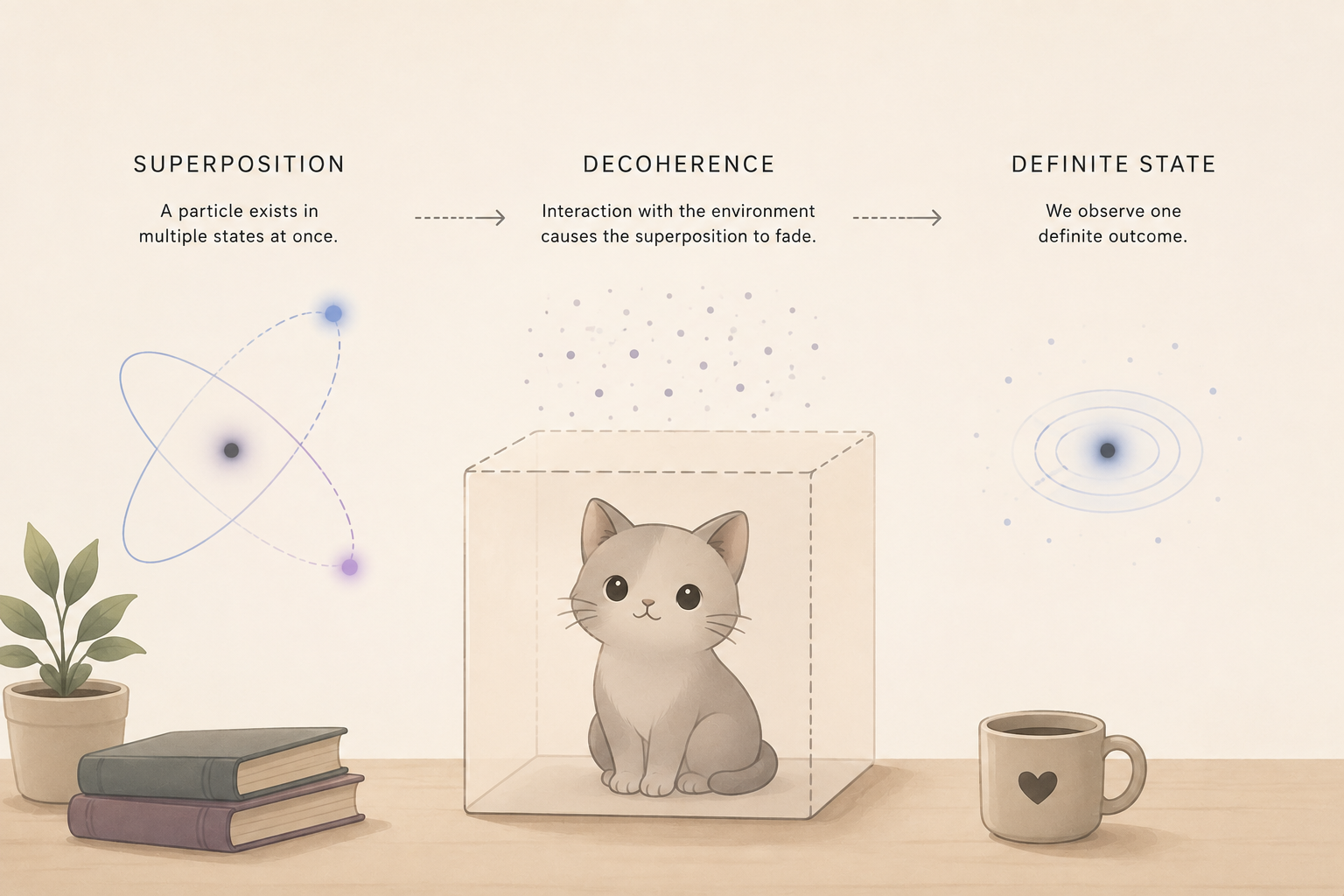
I've been fascinated by the idea of quantum superposition and what it might tell us about the nature of the reality we experience every day. If particles can exist in superpositions of different possible states, I've wondered what happens as we move from the microscopic world of particles to larger and increasingly complex things—and ultimately to the ordinary objects and living beings around us.
That question leads to something I find particularly interesting: Why does the quantum world appear so different from the reality we experience at human scales?
One important part of the answer is decoherence.
Superposition is one of the strangest features of quantum mechanics: a quantum system can exist in a combination of multiple possible states at the same time. For microscopic systems such as photons, electrons, atoms, and molecules, scientists can create conditions in which these superpositions persist long enough to produce observable interference. Remarkably, experiments have demonstrated quantum interference even with molecules containing thousands of atoms [1,2].
So why don't we see cats—or people, tables, or other everyday objects—existing in two places at once?
One of the strangest features of quantum mechanics is superposition: a quantum system can exist in a combination of multiple possible states at the same time.
For microscopic systems such as photons, electrons, atoms, and molecules, scientists can create conditions in which these superpositions persist long enough to produce observable interference. Remarkably, experiments have demonstrated quantum interference even with molecules containing thousands of atoms [1,2].
So why don't we see cats—or people, tables, or baseballs—existing in two places at once?
The answer has a great deal to do with decoherence.
Schrödinger’s Cat Was Meant to Illustrate a Problem
In 1935, physicist Erwin Schrödinger introduced his famous cat thought experiment to illustrate the strange consequences of extending quantum mechanics from microscopic particles to everyday objects.
Imagine a cat inside a sealed box. A quantum event—such as the decay of a radioactive atom—determines whether a mechanism is activated that effects the cat.
If the atom can exist in a superposition of “decayed” and “not decayed,” then applying quantum mechanics to the entire system appears to produce an extraordinary result:
The cat becomes entangled with the atom, producing a superposition involving both “alive” and “dead.” (by the way, isn’t it terrible how casually we discuss death of sentient feeling creatures?)
Yet this is obviously not how we experience animals or other macroscopic objects.
Why?
The Missing Ingredient Is Decoherence
A quantum superposition is extremely sensitive to interactions with its environment.
When a quantum system interacts with surrounding particles, photons, thermal radiation, or other environmental degrees of freedom, information about the system becomes dispersed into the environment.
This process is called environmental decoherence [3,4].
Decoherence suppresses the interference between different components of a superposition, causing the system to behave increasingly like the classical objects we encounter in everyday life [3].
This helps explain why quantum behavior is relatively easy to observe in carefully isolated microscopic systems but extraordinarily difficult to observe in large objects.
Does Mass Determine How Long Superposition Lasts?
Not by itself.
It is tempting to summarize the phenomenon as:
More mass → shorter superposition.
But the actual physics is more interesting.
There is no universal mass threshold at which quantum mechanics suddenly stops working. Instead, the persistence of observable quantum coherence depends on several factors, including:
mass and physical size,
temperature,
interactions with surrounding gas molecules,
interactions with electromagnetic radiation,
internal degrees of freedom,
how well the object is isolated from its environment,
and how different or spatially separated the superposed states are [3,4].
Mass nevertheless becomes important because increasingly massive and complex objects are generally much harder to isolate from their surroundings.
Experiments Have Already Put Surprisingly Large Objects Into Superposition
This distinction is important because quantum superposition is not limited to elementary particles.
In 1999, researchers demonstrated matter-wave interference using C60 molecules—“buckyballs” composed of 60 carbon atoms [1].
Twenty years later, researchers pushed the experiment dramatically further.
In 2019, Fein and colleagues demonstrated quantum interference with molecules exceeding 25,000 atomic mass units and containing up to approximately 2,000 atoms [2].
These experiments provide striking evidence that quantum mechanics does not simply stop applying when objects become larger.
Instead, maintaining observable quantum behavior becomes progressively more difficult.
Why a Cat Is Different
Now consider an actual cat.
A cat contains on the order of 10²⁷ atoms.
It is also warm.
It radiates heat.
Air molecules continually collide with it.
Photons continually scatter from it.
Its molecules interact internally.
Chemical reactions occur throughout its body.
Information about its physical state is therefore constantly becoming correlated with an enormous environment.
For a hypothetical superposition involving macroscopically different states of the cat, decoherence would occur extraordinarily rapidly [3,4].
The important point is that nature does not somehow recognize:
“This object is a cat, therefore quantum mechanics no longer applies.”
The underlying particles remain quantum mechanical.
Rather, a cat is so massive, complex, warm, and thoroughly coupled to its surroundings that maintaining observable quantum coherence across the entire animal becomes effectively impossible.
The Environment Is Constantly “Watching”
Physicist Wojciech Zurek developed an influential way of understanding this process.
The environment can effectively act as a continuous monitor of a quantum system [3].
Imagine that a particle exists in a superposition of two different locations.
Now imagine a photon strikes the particle.
The photon will scatter differently depending upon the particle's location.
Information distinguishing the two possibilities has therefore become encoded in the environment.
Now imagine another photon interacting with it.
And another.
Then an air molecule.
Then millions upon millions of additional interactions.
The quantum system becomes increasingly entangled with its surroundings, destroying our ability to observe interference between the alternatives [3].
For macroscopic objects, this process can happen astonishingly quickly.
The Quantum World Doesn't End Where the Classical World Begins
Perhaps the most fascinating implication is that there may be no simple boundary separating a “quantum world” from a “classical world.”
Quantum mechanics appears to continue applying as experiments move toward larger and more massive systems [2].
What changes is our ability to preserve and observe quantum coherence.
The classical world we experience may therefore emerge from an underlying quantum world through interactions between systems and their environments.
A particle can sometimes be sufficiently isolated for us to observe its superposition.
A cat cannot realistically be isolated in the same way.
And that means Schrödinger's famous paradox reveals something deeper than the absurd image of a simultaneously living and dead cat.
The cat doesn't stop obeying quantum mechanics because it is too large. Rather, its enormous number of interactions with the surrounding universe makes a cat-sized superposition decohere so rapidly that we never experience the cat as being in one.
In this sense, the boundary between the quantum and classical worlds may not simply be a boundary of size.
It is a boundary shaped by mass, complexity, information, interaction, and isolation.
References
[1] Arndt, M., Nairz, O., Vos-Andreae, J., Keller, C., van der Zouw, G., & Zeilinger, A. (1999). Wave–particle duality of C60 molecules. Nature, 401, 680–682. doi:10.1038/44348.
[2] Fein, Y. Y., Geyer, P., Zwick, P., Kiałka, F., Pedalino, S., Mayor, M., Gerlich, S., & Arndt, M. (2019). Quantum superposition of molecules beyond 25 kDa. Nature Physics, 15, 1242–1245. doi:10.1038/s41567-019-0663-9.
[3] Zurek, W. H. (2003). Decoherence, einselection, and the quantum origins of the classical. Reviews of Modern Physics, 75(3), 715–775. doi:10.1103/RevModPhys.75.715.
[4] Schlosshauer, M. (2005). Decoherence, the measurement problem, and interpretations of quantum mechanics. Reviews of Modern Physics, 76(4), 1267–1305. doi:10.1103/RevModPhys.76.1267.
